Commercial Floor Sanding in Dagenham RM8
Commercial timber floors in Dagenham RM8 rarely fail because they are simply “old”. In offices, shops, schools, restaurants, gyms, workshops and public buildings around Valence Avenue, Green Lane, Becontree Heath and towards Chadwell Heath, the usual problems are worn-through lacquer, ingrained traffic lanes, loose parquet, contaminated joints and areas polished smooth enough to become a slip concern.
We carry out commercial floor sanding and controlled timber restoration around operating hours, rather than treating a working building like an empty domestic property. Depending on what the floor actually needs, the job may involve full Commercial Floor Restoration in Dagenham, planned Commercial Floor maintenance in Dagenham, or cleaning, abrasion and recoating where Commercial Floor Polishing in Dagenham is more sensible than taking the floor back to bare timber.
The first question is not how quickly we can put a sanding machine on it. We establish what timber is down, how it is fixed, what previous coatings are present, whether moisture is involved and when the premises must return to service. That assessment determines the abrasive sequence, repairs, coating chemistry and programme.

Before and after commercial floor sanding in Dagenham RM8, restoring worn herringbone parquet flooring in a school classroom to a clean, smooth and durable finish.
Commercial Timber Floors in Dagenham RM8 Need a Different Approach
RM8 contains a broad mixture of building stock. We encounter timber in older institutional buildings, schools and halls, converted premises near established residential streets, post-war commercial units serving the Becontree area and heavily used shop, office and community interiors along the routes towards Chadwell Heath and Becontree Heath.
That matters because an old pitch-pine board floor behaves differently from quartersawn oak parquet or a later teak installation. Older buildings can also have suspended timber construction, historic bituminous residues, mixed repair timbers and decades of coating build-up that cannot be dealt with properly by running one aggressive grit across the whole floor.
Dagenham’s wider built environment also includes surviving historic fabric around Dagenham Village and buildings associated with the area’s rapid twentieth-century expansion. We therefore inspect first and remove only as much timber as necessary, particularly when an older floor has already undergone several sanding cycles.
Sectors We Regularly Plan Commercial Floor Work Around
Programmes can be adapted for private offices, coworking and serviced offices; shops, boutiques, showrooms and shopping-centre units; restaurants, cafés, pubs and takeaway premises; factories, workshops and manufacturing units; storage units, distribution centres and delivery depots.
We also plan work for gyms, cinemas, event venues and studios; hotels, hostels and serviced accommodation; clinics, dental practices and treatment rooms; and education or community premises including schools, colleges, universities, academies, churches, mosques and temples.
Each has different priorities. A restaurant may need grease contamination isolated before coating; a school needs predictable curing before pupils return; an office may need work phased around desks and access routes; a gym or event space places far greater demands on abrasion and slip performance.
Why Domestic Sanding Methods and Shop-Bought Polish Fail on Commercial Floors
A domestic floor may see a handful of people each day. A reception, shop, school corridor or restaurant can see hundreds of footfalls, chair movement, tracked grit, trolley wheels and repeated cleaning cycles before the week is out.
Applying ordinary polish over a degraded coating can make the floor look better briefly while doing nothing about the underlying failure. Worse, incompatible polish, silicone-containing cleaners, grease and old maintenance products can compromise adhesion when a proper lacquer is later applied.
- Open board and parquet joints: trap grit, food residue and cleaning moisture and can become difficult to maintain hygienically.
- Loose parquet blocks: move under loading, break filler and can develop raised edges or audible movement.
- Worn traffic lanes: expose raw timber, allowing water and contaminants to penetrate below the remaining finish.
- Over-polished surfaces: can alter slip characteristics, particularly around entrances, bars, counters, changing rooms and cleaning zones.
- Moisture ingress: can cause cupping, swelling, adhesive breakdown and black staining around steel fixings.
- Incorrect aggressive sanding: shortens the serviceable life of parquet and engineered wear layers by removing unnecessary timber.
- Contaminated substrates: including wax, silicone, grease and old adhesive residues can cause fisheyes, de-wetting or poor coating adhesion.
Where slip performance forms part of the client’s risk assessment, the finishing specification can be selected with BS 7976-2 Pendulum Slip Resistance testing in mind. A coating should be chosen for the actual use of the room, not because somebody prefers a particular level of shine.
Our Commercial Floor Sanding and Restoration Process
Step 1: Subfloor Audit & Moisture Testing
Before sanding starts we inspect the floor construction, timber thickness, previous repairs, perimeter movement, fixings and coating condition. We identify species where possible because pitch pine, oak and teak all cut differently and do not respond identically to stains, fillers or waterborne finishes.
Parquet is checked for hollow or loose blocks and board floors are checked for deflection, split tongues, proud nails and previous services cuts. Where there is any suspicion of moisture from a slab, screed, leak or ground-floor construction, hygrometer or appropriate moisture checks are carried out before a coating system is committed to.
Commercial sites receive a planned work method rather than an improvised start. Where required by the principal contractor or facilities manager, RAMS documentation and product COSHH assessments are prepared before mobilisation, with access arrangements, isolation areas, waste handling and out-of-hours working agreed in advance.
Step 2: Timber Repairs, Re-bonding & Resin Gap-Filling
There is little point putting a high-specification finish over moving timber. Loose parquet is lifted where necessary, old friable adhesive is removed and suitable blocks are re-bonded; where a flexible modern adhesive is appropriate we use silane-based parquet adhesive rather than relying on brittle spot repairs.
Damaged boards can be pieced in with compatible reclaimed or matching timber, paying attention to species, thickness and grain. On an older pitch-pine floor, dropping in pale modern softwood purely because it fits leaves a repair that will announce itself as soon as stain or lacquer goes down.
Fine stable joints can be treated using a resin-slurry gap-filling system made with clean sanding dust from the floor. Large or actively moving gaps need a different repair method; filling every opening with resin regardless of width is poor practice because seasonal movement can crack the filler straight back out.
Step 3: HEPA Dust-Controlled Sanding & Surface Preparation
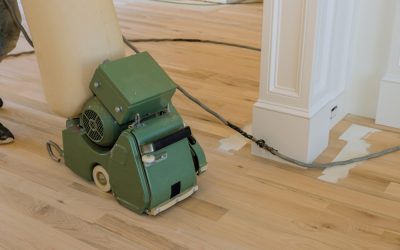
For the main field we use professional belt sanding equipment such as the Lägler Hummel where the floor construction suits it, followed by edging and controlled finishing passes. Grit progression is chosen from the condition of the timber; jumping from a coarse cut straight to a fine abrasive leaves deep scratches that show once the first coat wets the grain.
Dust is controlled at source with professional extraction, with HEPA H14 filtration deployed where the project specification or occupied-site controls require it. That is particularly important in offices, clinics, schools, hospitality premises and mixed-use buildings where fine sanding dust cannot be allowed to migrate through corridors, HVAC routes or neighbouring rooms.
Edges, radiator zones, thresholds and corners receive the same preparation standard as the middle of the room. Before coating, we remove abrasive debris methodically and inspect under working light for chatter, edging marks, swirl marks and missed contamination.
View examples of completed timber work in our floor sanding gallery. For budget planning, our published floor sanding prices provide a starting point, although commercial quotations are based on condition, access, phasing, repairs and the finish specification.

Professional commercial floor sanding in Dagenham RM8, restoring worn wooden floors to a smooth, clean finish.
Step 4: High-Traffic Finishes — 2K Lacquers, Hardwax Oils & Anti-Slip Systems
For hard-working commercial interiors we frequently specify professional 2K waterborne polyurethane lacquer. The cross-linking catalyst gives a chemically tougher film than a basic single-pack domestic varnish and is well suited to offices, schools, retail areas and hospitality floors where abrasion and repeated cleaning are expected.
The coating specification still depends on the substrate and use. Hardwax oil can be appropriate where a repairable, natural-looking finish is required, while selected commercial lacquer or anti-slip systems may be preferable in busy entrances, serving areas and public circulation spaces.
Low odour does not mean no controls are required. We review product safety data, ventilation requirements, mixing ratios, pot life and recoat windows, and can specify low-emission materials including EC1 Plus-rated products where the wider flooring or adhesive specification calls for very low VOC emissions.
Cure time is planned separately from “touch dry”. A floor can feel dry while the coating film is still developing chemical and abrasion resistance, so we agree when socks, normal foot traffic, furniture, rolling loads and full commercial use can resume rather than opening the room prematurely.
Step 5: Aftercare & Commercial Maintenance Protocols
The cheapest commercial floor to own is usually the one that is maintained before bare timber appears. We provide practical cleaning guidance covering entrance matting, grit removal, suitable pH cleaning products, chair protection and the point at which a maintenance coat should be booked.
For a sound lacquered floor, scheduled clean-and-recoat work can postpone another full sanding cycle considerably. That saves timber as well as downtime, which is especially important with engineered boards and older parquet where the available sanding thickness is finite.
We also advise facilities teams against generic supermarket polishes and silicone-rich products unless their compatibility is known. Some leave residues that create substantial preparation problems when the floor is eventually recoated.
Commercial Floor Sanding Without Closing the Building for a Week
On occupied sites the sanding is only half the job; sequencing is what keeps the premises usable. We can phase areas around trading, cleaning teams, deliveries, classroom timetables, hotel occupancy and office access rather than blocking the whole building unnecessarily.
| Working Pattern | Operational Benefit | Typical Facility Suitability |
|---|---|---|
| Overnight Shift | Main sanding and disruptive preparation completed after staff or customers leave, with agreed cure windows protected before reopening. | Retail units, offices, restaurants, cafés, clinics, gyms and reception areas. |
| Weekend Phased | Provides a longer uninterrupted window for sanding, coating and initial curing while reducing weekday disruption. | Schools, colleges, offices, dental practices, showrooms and community buildings. |
| Sectional Working | The floor is divided into controlled work zones so part of the building remains operational while other sections are restored. | Hotels, coworking spaces, warehouses, large offices, places of worship and event facilities. |
Section lines have to be chosen intelligently. Stopping a coating in the middle of an open oak floor can leave a visible lap, so we aim to break phases at doorways, movement joints, changes of board direction or other natural boundaries.
For factories, workshops, distribution premises and delivery depots, we also establish loading patterns and access routes before work starts. A newly coated floor should not receive pallet trucks, wheeled racks or concentrated loads simply because somebody can walk across it.

Before and after commercial floor sanding in Dagenham RM8, showing the transformation of a heavily worn solid timber floor in a community hall into a clean, professionally restored and finished surface.
Health, Safety and Occupied-Site Controls
Commercial work requires more paperwork and discipline than sanding an empty front room. Site-specific controls can include RAMS, COSHH assessments, segregation of the work area, cable management, extraction arrangements, fire-route planning and communication with the duty manager or principal contractor.
Where slip resistance is a project requirement, we can work to a specification that considers the BS 7976-2 pendulum test method and the floor’s intended contamination conditions. Restaurants, entrances, gyms and public buildings should not have their finish selected on gloss level alone.
We also check the practical implications of low thresholds, disabled access, door clearances and transitions to tile, vinyl or carpet. Raising a parquet repair by only a few millimetres in the wrong place can create a trip point or prevent a fire door from operating correctly.
Working with Older Dagenham Floors
Dagenham and the surrounding borough contain a mixture of surviving historic buildings and twentieth-century development associated with the growth of Becontree and the area’s industrial expansion. Older institutional rooms, churches, halls and converted premises can therefore present timber floors that have been patched, coated and repaired repeatedly over many decades.
A dark floor is not automatically oak and a reddish board is not automatically mahogany. We examine grain, pore structure, cut and existing exposed areas before making decisions; quartersawn oak may show prominent medullary rays, pitch pine often carries strong resinous growth lines, while teak presents its own oil-rich finishing considerations.
The aim is not to make an old floor look artificially new. It is to remove failed coatings and defects while retaining enough sound timber for the next restoration contractor to work with years down the line.
Commercial Site Assessment, Documentation and Quotation
We can start with site photographs, short video clips and a floor plan so we understand the likely area, access and visible defects before arranging the survey. For meaningful commercial work, the physical site survey remains important because photographs cannot confirm timber thickness, moisture conditions, loose blocks or coating contamination.
Our commercial site arrangements can include CSCS-carded operatives where required by site rules, together with evidence of appropriate commercial liability insurance and project-specific RAMS documentation. Product data and COSHH information can be supplied to facilities managers or principal contractors where the site procedure requires it.
The quotation identifies the proposed preparation, repairs, sanding and finishing system rather than hiding everything inside one square-metre figure. Where night working, restricted parking, furniture movement, multiple phases or unusually long curing windows affect the programme, those points are discussed before the start date.